


Labour Appeal Court Rules Employee’s Insolence Bars Return to Work


In this matter, CCI Call Centres (Pty) Ltd v Pinn (DA7/2024) [2025] ZALAC 24; [2025] 8 BLLR 781 (LAC); (2025) 46 ILJ 2083 (LAC) (17 April 2025), the employee was employed as a management accountant responsible for generating payment codes to enable salary payments.
In January 2019, after expressing dissatisfaction with not receiving a salary increase and a bonus, he refused to create the codes.
His refusal, made in an email that was copied to senior colleagues, included personal attacks on the Chief Financial Officer.
This conduct led to a breakdown in their working relationship.
Following a disciplinary hearing, the employee was dismissed for gross insubordination, gross insolence and inappropriate workplace conduct.
He referred the matter to arbitration.
The Arbitrator found the employee guilty of gross insubordination and inappropriate conduct, noting that his refusal to prepare payroll codes could have prevented thousands of employees from being paid on time.
Although the misconduct was serious, the Arbitrator held that dismissal was too harsh, especially given the uncertainty around his job description.
However, reinstatement was deemed impractical due to the breakdown of trust between the employee and the Chief Financial Officer.
Instead, the employee was awarded compensation equivalent to one month’s salary.
The employee challenged the Arbitrator’s award, arguing that he should have been reinstated with full back pay or, alternatively, received up to 12 months’ compensation.
The Labour Court agreed, finding that the Arbitrator had erred by not reinstating him.
It substituted the award with an order of retrospective reinstatement, reasoning that there was insufficient proof of an irretrievable breakdown in the employment relationship.
The employer appealed to the Labour Appeal Court.
The LAC held that the Labour Court had misapplied the law by effectively re-hearing the case instead of applying the correct test for review: whether the Arbitrator’s decision was one that a reasonable decision-maker could have made.
The Court emphasised that the Arbitrator had carefully weighed the employee’s serious misconduct against the fairness of dismissal, concluding that reinstatement was untenable due to the collapse of the trust relationship.
The LAC criticised the Labour Court for disregarding substantial evidence of the employee’s insubordination and disrespect, which struck at the core of the employment relationship.
The LAC upheld the appeal, setting aside the Labour Court’s order of reinstatement.
The Arbitrator’s original award of one month’s compensation was confirmed. Each party was ordered to bear its own legal costs.
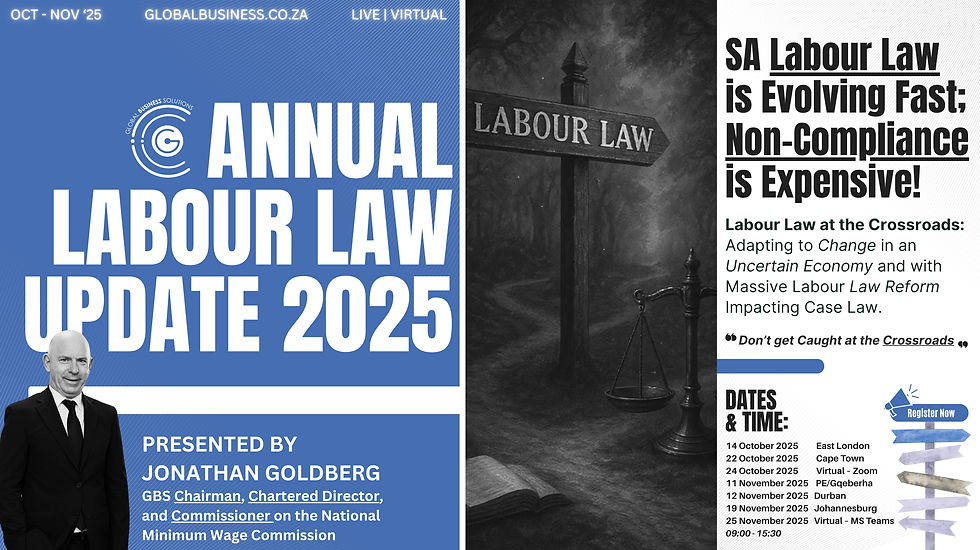
Join us at the Annual Labour Law Update. This year's theme is Labour Law at the Crossroads: Adapting to Change in an Uncertain Economy and with Massive Labour Law Reform Impacting Case Law. What you'll gain:
Master the Digital Transformation of Labour Law in 2025
200+ Labour Law Cases Unpacked by Jonathan Goldberg
Critical Updates on Upcoming Legislation & NEDLAC Amendments
Navigate Workplace Challenges from the Digital Era to Discrimination Laws
View our upcoming events: Upcoming Events and Qualifications, like Landmark Judgment: Equal Parental Leave for All Parents, Managing Absenteeism in the Workplace, #ALLU2025, Advanced Occupational Certificate: HRM Officer (NQF 6), and Advanced Occupational Certificate: HRM Officer (NQF 6).
*All workshops are offered as customised in-house training that can be presented virtually or on-site.
"Global Business Solutions (GBS)—Your Partner in Strategic HR Compliance"


Comments