


Practical AI Training in South Africa: How to Build AI Skills for the Workplace


Artificial intelligence is becoming part of everyday business, but there is a significant difference between knowing about AI and knowing how to use it effectively at work.
Many professionals have experimented with ChatGPT, Claude or Microsoft Copilot, yet still struggle to translate these tools into better processes, faster workflows or measurable productivity improvements.
That is why practical AI training is becoming increasingly important.
The objective should not simply be to explain artificial intelligence. Employees need to learn how to prompt effectively, identify appropriate use cases, improve processes, automate repetitive work and build practical AI-enabled tools.
What is practical AI training?
Practical AI training focuses on applying artificial intelligence to real workplace problems rather than only teaching AI theory.
A useful programme should help employees understand:
How generative AI works;
How to write effective prompts;
Which AI platforms are suited to different tasks;
How Microsoft Copilot can support everyday work;
How to identify processes suitable for AI or automation;
How to create reusable AI workflows;
How bots and AI assistants can be built;
How to use AI responsibly and securely.
The goal is to move employees from experimenting with AI to applying it systematically in their roles.
What AI skills do employees need?
Employees do not necessarily need programming or data-science backgrounds to become capable AI users.
For many professionals, the most useful skills are practical ones.
Prompt engineering
Employees need to know how to provide AI with clear instructions, relevant context, constraints and expected outputs.
Better prompting can significantly improve the quality and usefulness of AI-generated work.
AI tool selection
ChatGPT, Claude, Microsoft Copilot and other AI platforms have different strengths.
Employees should understand which tools are appropriate for different tasks rather than relying on one platform for everything.
Process mapping
Before automating something, employees need to understand how the existing process works.
Mapping workflows can reveal repetitive administration, unnecessary hand-offs and opportunities where AI can create genuine value.
Automation
Once a suitable process is identified, AI and automation tools can help reduce repetitive work and improve consistency.
AI governance
Employees also need to understand confidentiality, personal information, data protection, intellectual property and the importance of checking AI-generated outputs.
How can businesses use AI in everyday work?
Practical AI applications can be found throughout an organisation.
Employees may use AI to:
Draft and improve documents;
Summarise lengthy information;
Analyse data and reports;
Research topics;
Develop policies and procedures;
Prepare presentations;
Create reusable templates;
Analyse processes;
Generate ideas;
Improve customer communications;
Build internal knowledge tools;
Automate repetitive administrative activities.
In HR, Employee Relations and Compliance environments, AI can also assist with policies, Employment Equity documentation, performance-management processes, labour-law research and structured workplace documentation.
The strongest use cases are normally those that solve an identifiable business problem rather than introducing AI simply because the technology exists.
What is prompt engineering and why does it matter?
Prompt engineering is the ability to communicate effectively with generative AI.
A vague instruction will usually produce a generic answer.
A stronger prompt provides the AI with:
A role;
Clear context;
The task required;
Relevant information;
Constraints;
The required format;
Instructions about what it should not assume.
Professional prompting can turn AI from an occasional writing assistant into a much more useful workplace productivity tool.
Employees can also create reusable prompt libraries for recurring activities instead of starting from scratch each time.
How can Microsoft Copilot be used in business?
Microsoft Copilot is increasingly relevant to organisations already working within the Microsoft environment.
Depending on the organisation’s licence and setup, Copilot can support activities involving documents, email, meetings, presentations, spreadsheets and other everyday Microsoft workflows.
However, giving employees access to Copilot does not automatically create productivity.
Employees still need to understand how to prompt effectively, select suitable tasks and redesign workflows around AI.
This is why tool training should be combined with process thinking.
Can employees build their own AI bots and workflows?
Increasingly, yes.
Modern AI tools are making it possible for business professionals to create simple bots, assistants and automated workflows without needing to become traditional software developers.
For example, organisations may build tools that assist employees with:
Internal policies;
Frequently asked questions;
Document generation;
Compliance processes;
HR administration;
Research;
Decision support.
The key is understanding both what should be automated and how to implement it responsibly.
Who should attend practical AI training?
Practical AI capability is useful across many roles, including:
HR professionals;
Employee and Labour Relations practitioners;
Compliance professionals;
Managers;
Executives;
Business owners;
Transformation professionals;
Operations teams;
Administrative professionals.
The training is particularly useful for people who already understand that AI matters but now want to know how to use it properly in their work.
Where can businesses find practical AI training in South Africa?
Organisations should look for programmes that combine AI fundamentals with practical workplace application, process improvement, governance and automation.
Global Business Solutions provides AI training, Digital Intelligence consulting, process automation and workplace AI capacitation to organisations across South Africa.
GBS supports clients in East London, Gqeberha/Port Elizabeth, Cape Town, Johannesburg, Pretoria and the broader Gauteng region, Durban, as well as organisations nationwide through virtual and on-site engagements.
The focus is on helping professionals move beyond AI theory and develop tools, prompts and workflows they can apply in their everyday work.
A practical next step
For professionals wanting more than a short introductory webinar, GBS is presenting the AI Compass: High Impact Workshop Series across four live online sessions in November and December 2026.
The programme condenses the practical learning developed through the broader AI Compass programme into four focused workshops:
11 November: AI Fundamentals;
18 November: Prompting Like a Professional;
25 November: Microsoft Copilot & Process Mapping;
02 December: Bot Building & the Future of AI.
Each session runs from 10:00–13:00, giving delegates 12 hours of practical AI development across the four-week programme.
Participants progress from understanding AI and professional prompting to process mapping, Microsoft Copilot, automation and bot building, while also considering governance, data and responsible AI use.
Format: Four live online workshops
Investment: R14,500 excluding VAT
The programme is facilitated by John Botha, Courtenay Botha and Joshua Botha, combining expertise in workforce strategy, business transformation and practical AI implementation.
Rather than leaving with AI concepts alone, the objective is for delegates to leave with reusable prompts, practical techniques, improved workflows and an AI adoption roadmap they can apply within their organisation.
This article is for informational purposes only and does not constitute legal advice. For specific legal guidance on protected disclosures, employment practices, or compliance obligations, consult a qualified labour law practitioner.
© 2026 Global Business Solutions (GBS). All rights reserved.
Stay ahead of South Africa’s changing labour law
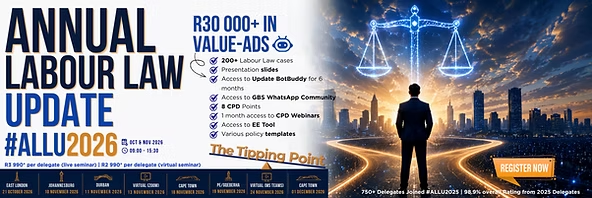
South Africa’s workplace laws are reaching The Tipping Point. Join us at #ALLU2026 – the Annual Labour Law Update for a practical update on the latest case law, legislative changes, Employment Equity developments, AI in the workplace and the issues employers need to prepare for now.
Get the insight. Understand the impact. Make better workplace decisions.
View our upcoming events: Upcoming Events and Qualifications, like #ALLU2026; CLAUDE for Employment Relations; KZN Employment Equity Reporting 2026: Sector Targets, DG Reviews & Compliance; AI & the Future of Work: The CHRO Roadmap; Shop Stewards: Mastering Roles & Responsibilities and the AI Compass High Impact Workshop Series (Only 4 Sessions).
*All workshops are offered as customised in-house training that can be presented virtually or on-site.


Comments